Benchmark results
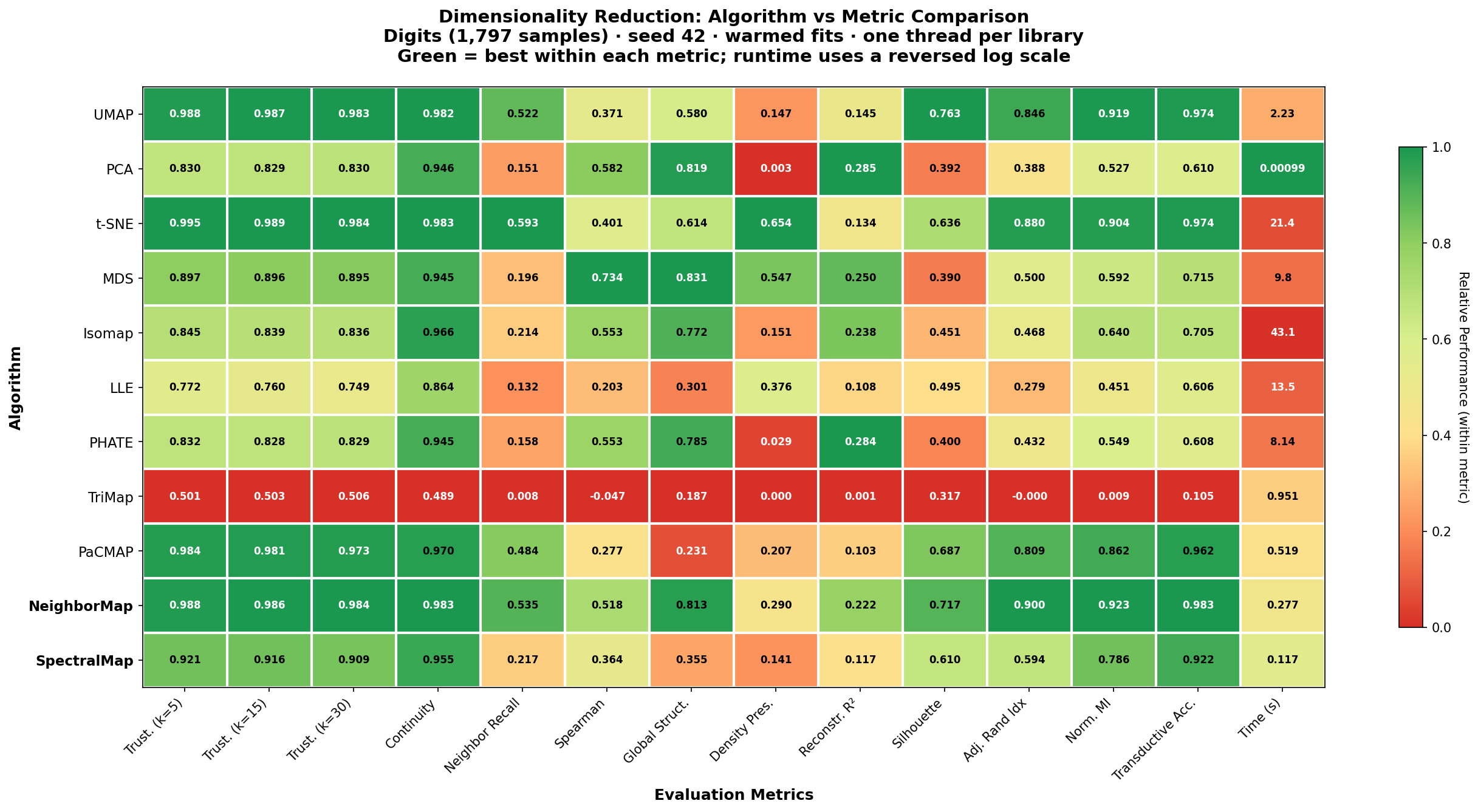
The current heatmaps compare 11 algorithms on Digits and a balanced
2,000-image Fashion-MNIST sample. Both include NeighborMap and SpectralMap.
Each method uses seed 42, one full-data warmup excluded from timing, and a
single thread per numerical library. Time measures fit_transform, not scoring.
These are single-seed snapshots. Use the repeated-seed runner below to inspect variation; no general significance or large-data scalability claim follows from the heatmaps alone.
Circular performance profiles
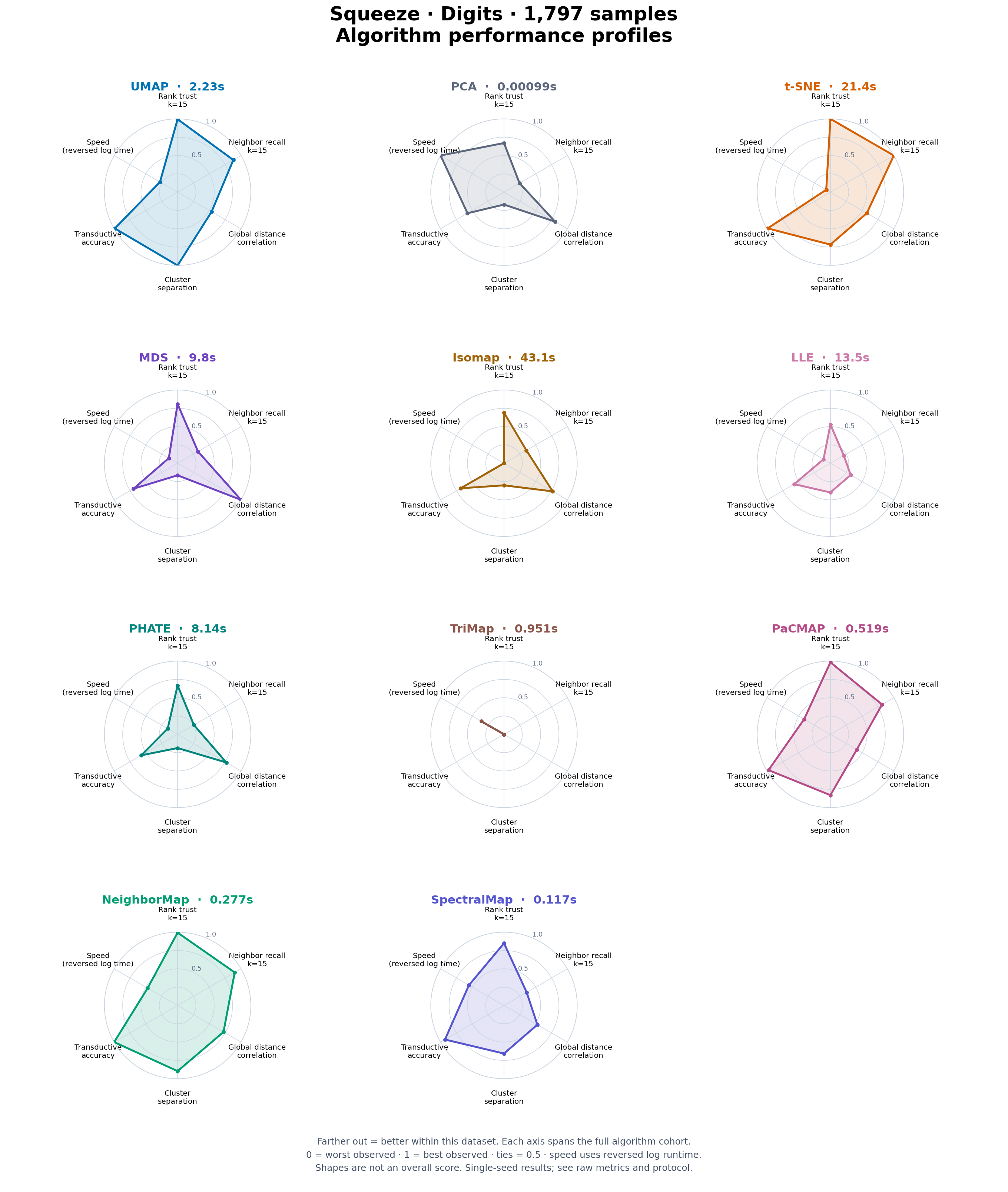
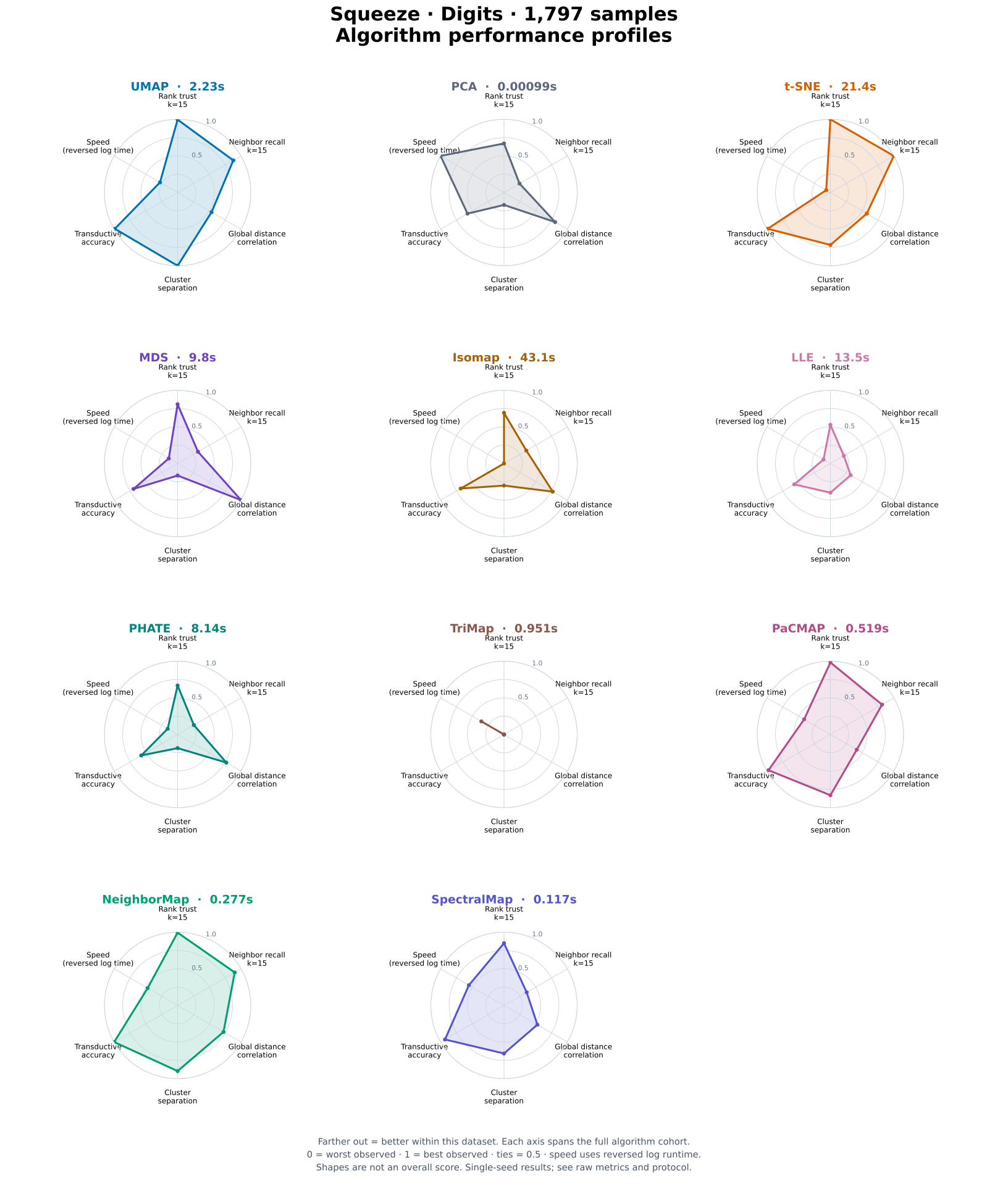
The radar charts show six complementary metrics: rank trustworthiness, neighbor recall, global distance correlation, cluster separation, transductive accuracy, and speed. Farther from the centre is better. Each axis is scaled from the worst to the best observed result across all 11 algorithms within that dataset; 0 is not zero absolute capability. Speed uses reversed log runtime. Tied axes sit at 0.5. These relative shapes are not comparable across datasets and polygon area is not an overall score; exact values remain available in the table.
Select algorithms to overlay below. The axes stay fixed when you change the selection. Open the standalone chart for a larger view or download the figures.
Digits radar
Open interactive chart · PNG · SVG
Fashion-MNIST radar
Open interactive chart · PNG · SVG
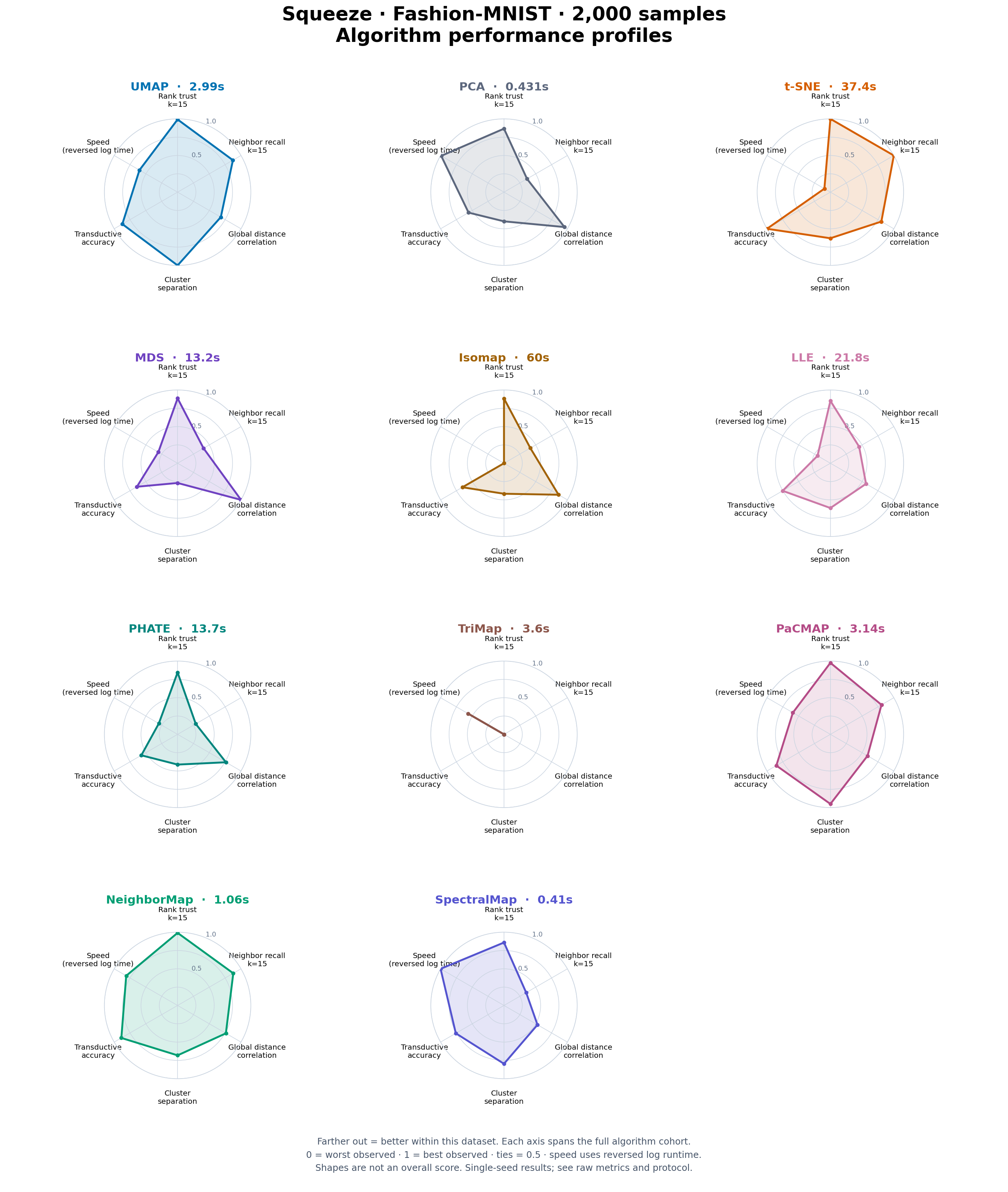
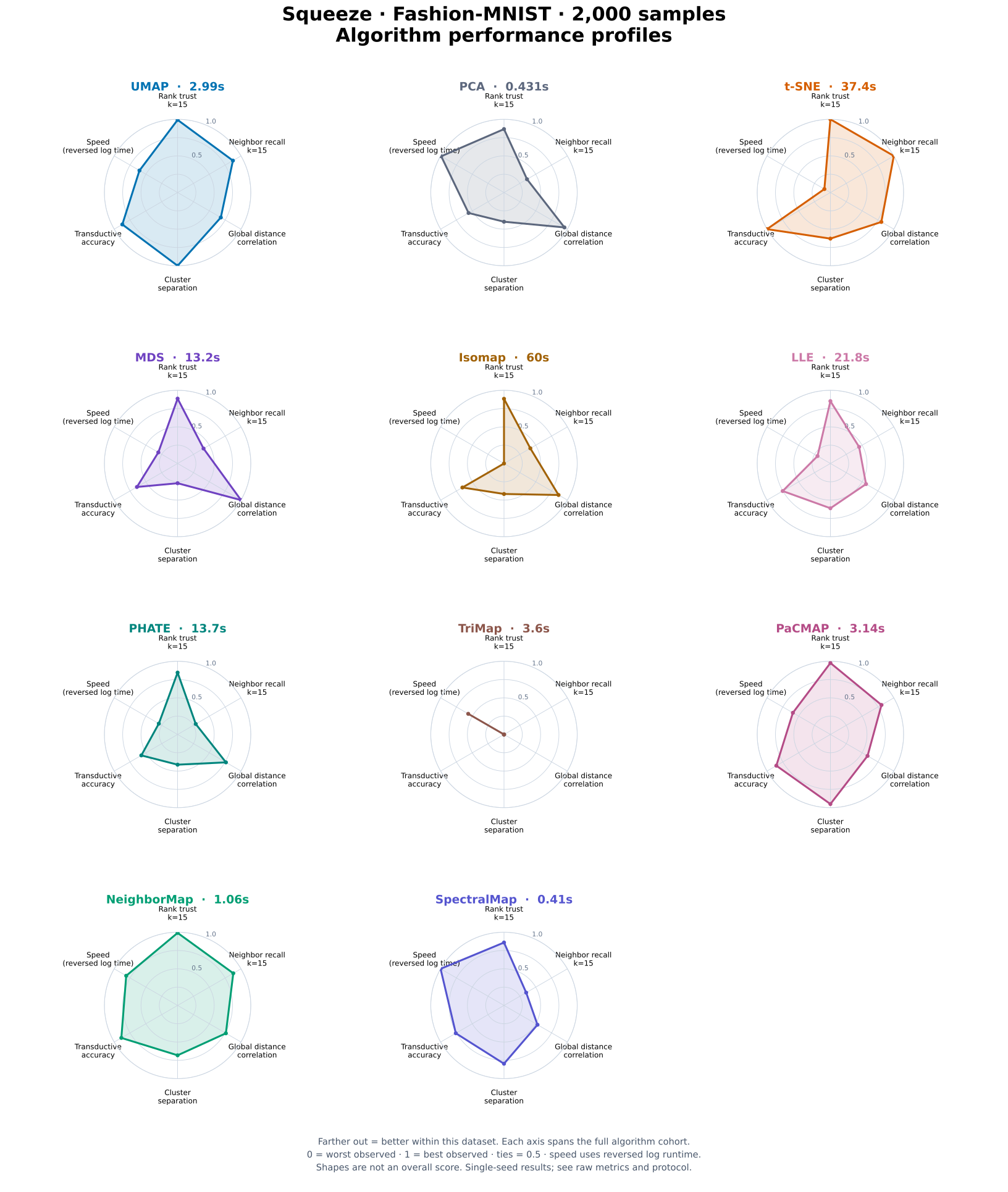
Static figures show one radar per algorithm to keep all 11 profiles readable. The charts reuse the saved heatmap CSVs; generating them does not rerun any fits.
Digits · 1,797 × 64
Fashion-MNIST · 2,000 × 784
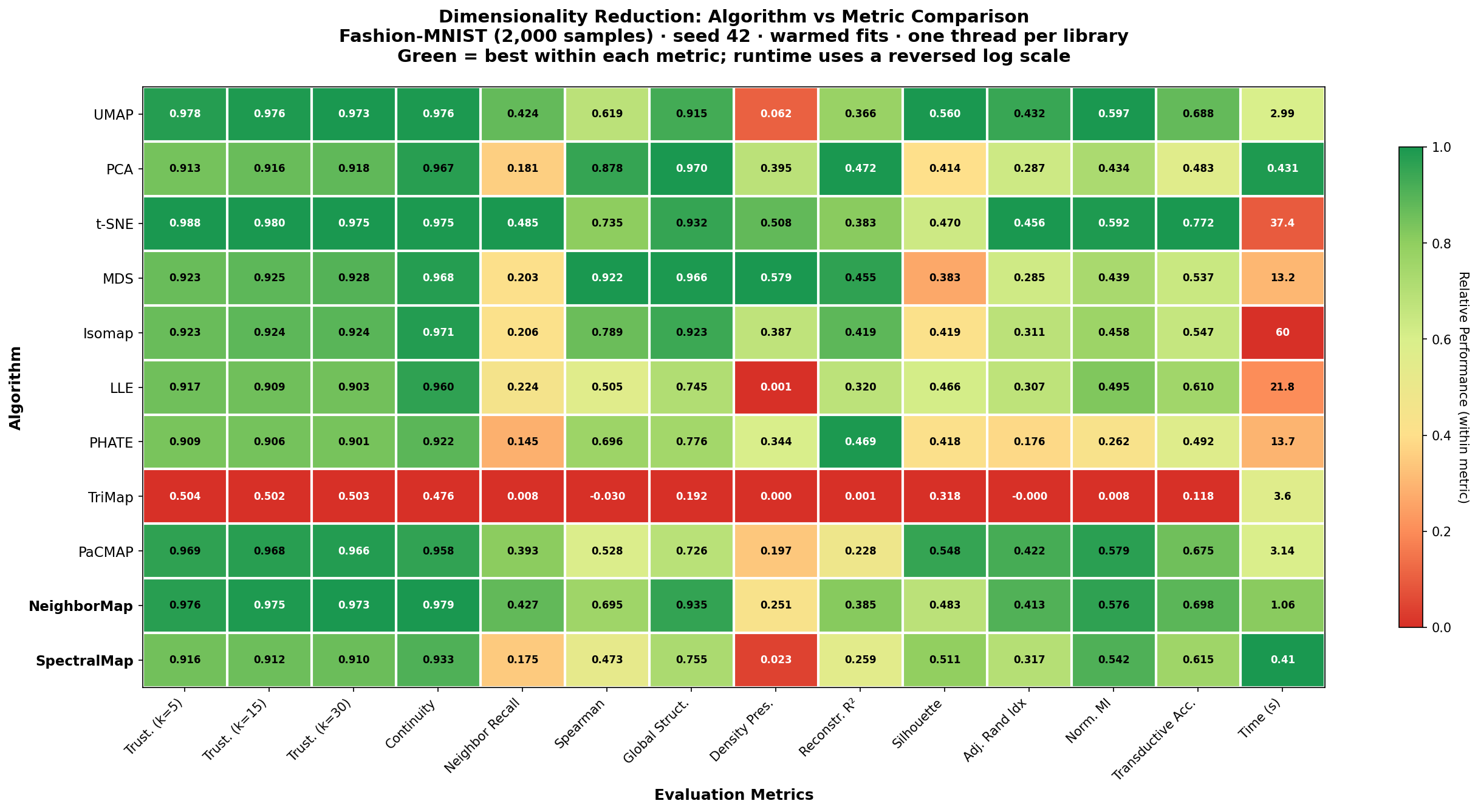
Download the full Fashion-MNIST CSV
The new method names are bold. Green indicates better performance within a column. Rank trustworthiness, neighbor recall, and transductive classification accuracy have different meanings: read the metric definitions before comparing them. Sample selection is documented in Datasets.
Reproduce the charts
Build the current extension, then run:
uv run --no-sync python benchmark_metrics_heatmap.py
uv run --no-sync python benchmark_metrics_heatmap.py --dataset fashion-mnist --samples 2000
Digits writes the root PNG/CSV and saves embeddings/protocol under
working_docs/heatmap_refresh/digits. Fashion-MNIST writes its artifacts
under working_docs/heatmap_refresh/fashion-mnist. --output-dir PATH keeps
all output files together at a custom location. Use --help for options.
The benchmark now also generates metrics_radar.png, metrics_radar.svg and
metrics_radar.html alongside its heatmap. To redraw the documentation figures
from the saved results without rerunning algorithms:
uv run --no-sync python -m scripts.benchmark_radar metrics_results.csv --output-dir docs/assets/benchmarks/digits-radar --title "Digits · 1,797 samples"
uv run --no-sync python -m scripts.benchmark_radar working_docs/heatmap_refresh/fashion-mnist/metrics_results.csv --output-dir docs/assets/benchmarks/fashion-mnist-radar --title "Fashion-MNIST · 2,000 samples"
Repeated-seed comparisons
OPENBLAS_NUM_THREADS=1 OMP_NUM_THREADS=1 NUMBA_NUM_THREADS=1 RAYON_NUM_THREADS=1 \
uv run --no-sync python -m scripts.benchmark_neighbors \
  --dataset fashion-mnist --samples 2000 --output working_docs/fashion_comparison
uv run --no-sync python -m scripts.report_neighbors working_docs/fashion_comparison
Omit the dataset/sample arguments to use Digits. The runner records per-seed measurements and coordinates; the report provides interactive scatter plots and runtime/quality comparisons. The Performance Benchmarks GitHub workflow also offers a dataset selector for manual runs. Pull-request CI uses Digits.
Evidence and provenance
- Heatmap protocol and source revision
- Saved Digits embeddings and protocol
- Saved Fashion-MNIST embeddings and protocol
- Earlier three-seed graph comparison
The measured Fashion implementation is retained at commit 99f4935. Later
output-path and documentation changes do not change its fits or metrics.
Older working reports may label overlap as trustworthiness; their original
measurements are retained as historical evidence, not rewritten as rank scores.